TheraPlay4Kids Guest Speaker Series
How to Make Sense of the Paperwork in Your Child’s Therapy Journey

How to Make Sense of the Paperwork in Your Child’s Therapy Journey
Sheila Olson owner and creator of Fit Sheila
Parents and caregivers of children with sensory processing challenges, developmental delays, or cognitive differences often become the unofficial record keepers of their child’s care. Evaluations, therapy notes, school documents, medical reports, recommendations, and appointment summaries can quickly become a second workload layered on top of parenting.
The problem is not simply having “too much paperwork.” Each document may contain information that affects what happens next: a therapy recommendation, an accommodation, a measurable goal, an observation about progress, or a question that needs to be raised with another professional. A manageable system helps turn that pile of records into something useful.

What Matters Most
You do not need to memorize every report or understand every clinical term. You need a reliable way to find important information when a decision has to be made.
A practical documentation system should help you do four things: know where records are, understand the major findings, keep track of unanswered questions, and bring the right information to the right person.
That distinction matters. The goal is not perfect paperwork. The goal is being prepared when a therapist asks about an earlier evaluation, when a teacher needs an accommodation clarified, or when an IEP meeting requires you to compare current goals with previous ones.
Why the Paperwork Becomes Overwhelming So Quickly
A child's records are rarely written as one continuous story. An occupational therapist may focus on sensory regulation and daily functioning. A psychologist may discuss testing results and cognitive patterns. A school team may document educational performance, services, accommodations, and measurable goals.
Parents are left to connect those pieces.
Long evaluation reports can make this particularly difficult. A 20- or 40-page assessment may contain pages of background, test descriptions, scores, observations, interpretations, and recommendations. IEPs introduce educational and legal terminology. Meanwhile, therapy progress notes keep arriving, and medical reports may contain useful findings without clearly explaining which details should influence everyday decisions.
The result is predictable: important information can become harder to see precisely because there is so much information surrounding it.

Build a System Before You Need One
A filing system does not need to be elaborate. It needs to be consistent.
A useful starting structure is:
Evaluations: psychological, developmental, occupational therapy, speech-language, physical therapy, and other formal assessments
School: IEPs, meeting notices, progress reports, accommodations, eligibility documents, and relevant correspondence
Therapy: treatment plans, progress summaries, home recommendations, and discharge reports
Medical: specialist reports and other records relevant to development or therapy
Working notes: questions, observations, appointment notes, and issues you want to revisit
Use the same broad categories whether you keep paper binders, digital folders, or both. Add dates to filenames so you can distinguish current documents from older ones without opening every file.
Which Documents Deserve Your Attention?
Not every page has equal importance at every stage.
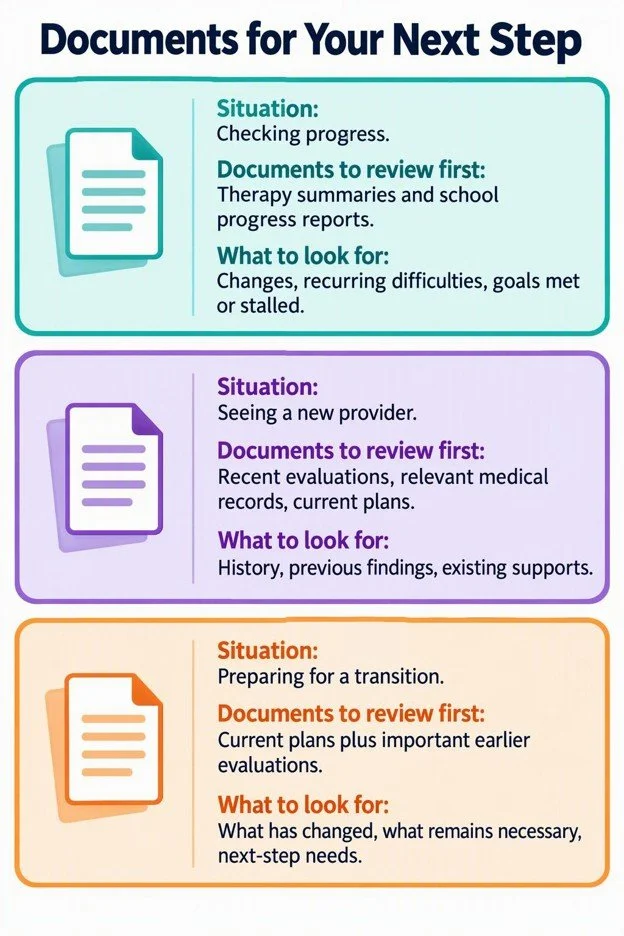
A Five-Step Paperwork Reset
If your child's records already feel unmanageable, do not start by reading everything again.
Step 1: Gather. Put existing records into one physical or digital location.
Step 2: Sort. Separate evaluations, school records, therapy documents, medical information, and your own notes.
Step 3: Identify the current version. Mark the latest IEP, evaluation, therapy plan, and other documents you use regularly.
Step 4: Create a question log. Keep one running note for things you want to ask therapists, teachers, physicians, or school staff. Add questions when they occur to you instead of relying on memory during appointments.
Step 5: Share selectively. Give professionals the records that provide useful context rather than automatically forwarding your child's entire archive. Ask what documentation they need, and use appropriate secure methods for sensitive records.
The result is a working record system rather than an archive you are afraid to open.

When a Long PDF Is the Problem
Sometimes organization is not the obstacle; interpretation is. A parent may know exactly where an evaluation is stored and still struggle to locate the three recommendations buried inside 30 pages of testing language.
One option is an AI-powered document tool that allows parents to chat with pdf files online. Instead of repeatedly scanning a long report, a parent can ask plain-language questions about the document—for example, where accommodations are discussed or what recommendations appear in a particular report. That can make it easier to identify passages worth revisiting before an appointment, IEP meeting, or conversation with a teacher or clinician.
These tools should assist your reading, not replace professional interpretation. Check important answers against the original document, especially when a decision concerns your child's education, health, services, or legal rights.

Keep the Questions With the Records
A surprisingly useful habit is maintaining a running question list alongside your child's documents.
Write down the question when it occurs:
Is this goal still appropriate?
Why does the school report describe something differently from the therapy note?
Should this recommendation be used at home?
Has this accommodation actually been implemented?
That small practice changes paperwork from passive storage into preparation. You arrive at meetings with specific issues to discuss rather than trying to reconstruct three months of observations in the parking lot.
A Reliable Place to Learn About IEPs
When school paperwork becomes difficult to interpret, use authoritative resources rather than relying solely on summaries from social media or other parents' experiences.
The U.S. Department of Education's IDEA Parents and Families resource brings together information about IEPs, early intervention, procedural safeguards, Parent Training and Information Centers, and other family resources. The Department notes that Parent Training and Information Centers provide services across every state and several U.S. jurisdictions, making them another useful starting point when families need help understanding the special-education process.

Frequently Asked Questions
Do I really need to keep all of my child's paperwork?
You do not need to treat every page as equally important, but keeping an organized history can be valuable because earlier evaluations, plans, and progress reports provide context for later decisions. Rather than routinely discarding older records, separate current working documents from historical records. If you are unsure whether a particular educational, medical, insurance, or legal record should be retained, check the applicable requirements or ask the relevant professional before disposing of it.
Documentation Is Part of the Journey
Managing records will never be the most meaningful part of supporting a child with sensory or developmental needs, but it can make the meaningful parts easier. A good system helps parents see patterns, remember questions, communicate across teams, and enter important meetings with context already in hand.

More Information on Sheila Olson and her Fit Sheila website can be found by clicking the active links below:
Sheila Olson has been a personal trainer for five years. She created Fit Sheila to spread the word about her fitness philosophy and encourage her clients to stay positive. She incorporates mindfulness and practices for reducing negative talk into her sessions.
Fit Sheila website - Click & Go!

sHEILA OLSON
Personal Trainer, Owner & Creator of Fit Sheila