TheraPlay4Kids.com Guest Speaker Series
Sensory Regulation in Autism Looking Beyond Behaviour
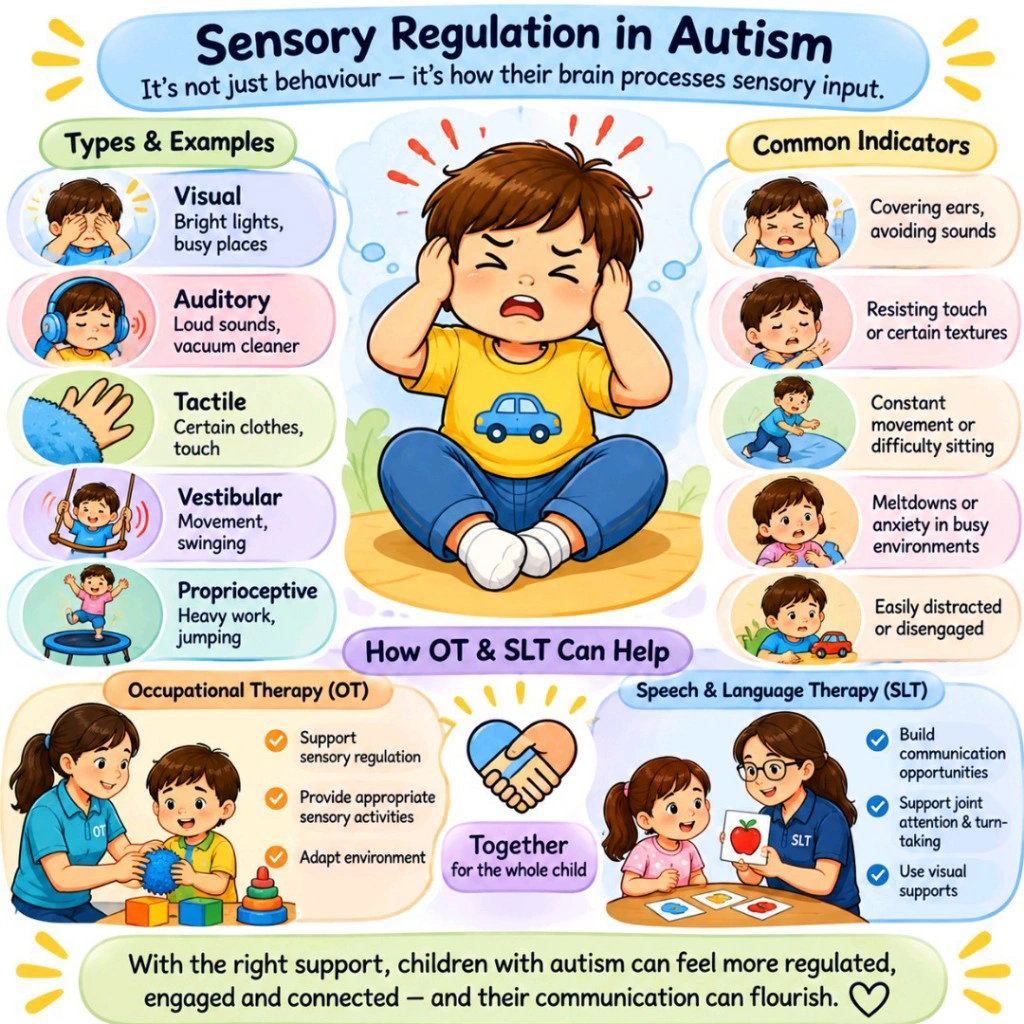
Created by Maria Akter - Speech and Language Therapist
Maria Akter - Speech and Language Therapist
Sensory Regulation in Autism Looking Beyond Behaviour
Sensory regulation is the process of managing and responding to sensory information from the environment and our body so we can participate in everyday activities.
A child may experience sensory input as:
Too much — hypersensitivity/over-responsiveness
Too little — hyposensitivity/under-responsiveness
Seeking more input — sensory-seeking behaviours
Different responses depending on the environment, activity, fatigue or stress
A child's sensory response can affect attention, play, learning, communication, eating, transitions and participation. These behaviours may sometimes reflect differences in sensory processing and regulation not simply “bad behaviour” or a lack of cooperation.

Common Sensory Response Patterns
1. Sensory over-responsiveness
- Covering ears in response to sounds
- Avoiding bright lights or crowded spaces
- Distress with certain clothing or textures
- Becoming overwhelmed by unexpected sensory input
2. Sensory under-responsiveness
- Reduced noticing of some sensory input
- Appearing less responsive to environmental cues
- Difficulty noticing body signals or sensory changes
3. Sensory seeking
- Repeated jumping, rocking or movement
- Seeking sounds, touch or visual stimulation
- Enjoying pushing, pulling or other body-based activities
A child may show more than one pattern, and their responses may change depending on the environment, fatigue, stress, activity and individual needs.

Sensory Differences
🔊 Auditory differences: Background noise may make it more difficult for a child to attend to spoken language or understand communication in a busy environment.
👀 Visual differences: Visual clutter may compete with attention during play, learning or communication activities.
🖐️ Tactile differences: Discomfort with textures may affect play, dressing, feeding or participation in therapy.
🏃 Movement and proprioceptive needs: A child may need movement or body-based activities to feel comfortable and participate in an activity.
💭 Interoceptive differences: Difficulty noticing internal body signals may make it harder to recognise or communicate hunger, thirst, pain, toileting needs or discomfort.
Sensory differences do not automatically mean a child has a communication disorder. However, they may create barriers to communication, learning and participation that clinicians should consider.

Supportive Goals
🤝Our goal should not simply be to make a child sit still, suppress sensory behaviours or tolerate every sensory experience.
Instead, we should aim to understand the child's sensory experiences, respect their communication, support autonomy and create environments where they can participate comfortably and meaningfully.
Regulation is not about compliance. It is about supporting access, comfort, communication and participation.
When OT and SLT work together, we can look beyond observable behaviour and better understand what the child may need to engage, communicate and thrive.

More Information on Maria Akter, SLP, and the great information she is sharing can be found by clicking the active link below:
I am a Speech and Language Therapist from Bangladesh, with a special interest in Autism Spectrum Disorder (ASD), child communication development, and neurodiversity.
I enjoy exploring and sharing topics related to autism and communication patterns, echolalia, gestalt language processing, joint attention, and social communication.
Maria Akter on LinkedIn (Click & Go!)

Maria Akter, Clinical Speech & Language Therapist
Special interest in Autism Spectrum Disorder (ASD), child communication development, and neurodiversity